
15-Year vs 20-Year vs 30-Year Home Loan: The Complete Comparison
Published on March 1, 2026
Key Takeaways
- 15-Year: High EMI, lowest interest. Best for aggressive wealth builders.
- 30-Year: Lowest EMI, brutal interest (you buy the house twice). Avoid if possible.
- The 20-Year Sweet Spot: The mathematical middle ground that balances manageable cash flow with reasonable interest costs.
Meet the Patels. They want a ₹50 Lakh loan. The bank offers a 30-year option, dropping the EMI to an attractive ₹38,446. It feels like a steal until you look at the final bill. By avoiding a slightly higher EMI today, the Patels are signing a contract to pay ₹88.4 Lakhs in interest alone on a ₹50 Lakh property.
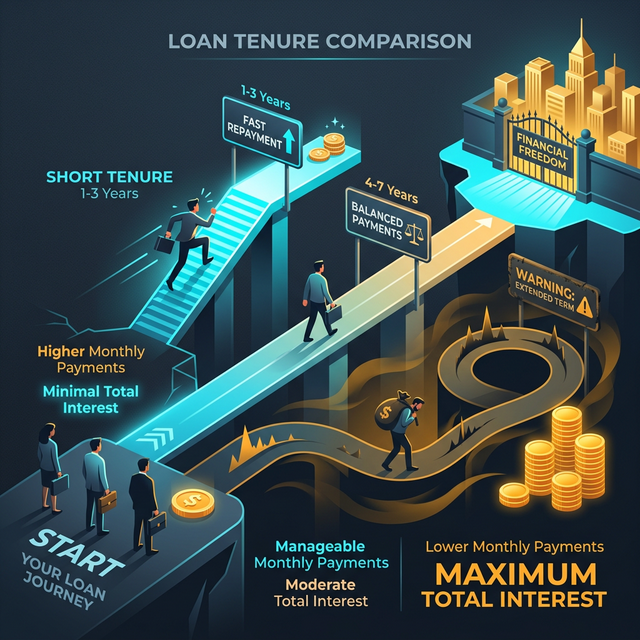
The Hidden Math: The Scaling Penalty of Time
Time is the ultimate multiplier of compound interest. Let's compare the exact mathematics for a ₹50 Lakh loan at 8.5% across the three standard tenures:
| Tenure | Monthly EMI | Total Interest Paid | Total Outflow |
|---|---|---|---|
| 15 Years | ₹49,237 | ₹38,62,656 | ₹88.6 Lakhs |
| 20 Years | ₹43,391 | ₹54,13,879 | ₹1.04 Crores |
| 30 Years | ₹38,446 | ₹88,40,432 | ₹1.38 Crores |
The Solution: The 'Stretch & Prepay' Hybrid
What if you want the safety of a low EMI but hate paying the massive interest of a 30-year loan? The NestSaver strategy is to take the 25 or 30-year loan for safety, but pay it like a 15-year loan.
This gives you a mandatory lower obligation if you lose your job, but allows you to voluntarily aggressively prepay while times are good, effectively securing the 15-year total interest rate.
Want to find your true sweet spot? Slide the tenure control on the NestSaver Simulator to see the interest curve bend.
The Cost of Inaction
Accepting a 30-year loan without a prepayment strategy means condemning yourself to working an extra decade just to pay off interest to a bank.
Compare Tenures Instantly
Visualize the exact difference between a 20-year and 30-year loan on our dashboard.
Launch Smart Simulator